Upper & Lower Body Training
In case you’re looking for a balance which would allow you to target the most muscles in shortest time, then look no further. Upper / Lower split would suit you the best, as it brings the most balance to your training routine.
Upper body training days focus on developing the muscles of the torso and arms, including the chest, shoulders, back, biceps, triceps, traps, forearms, and often the core.
Lower body training days target the muscles from the hips down, such as the quads, hamstrings, glutes, calves, and lower back, with core work sometimes included as well.
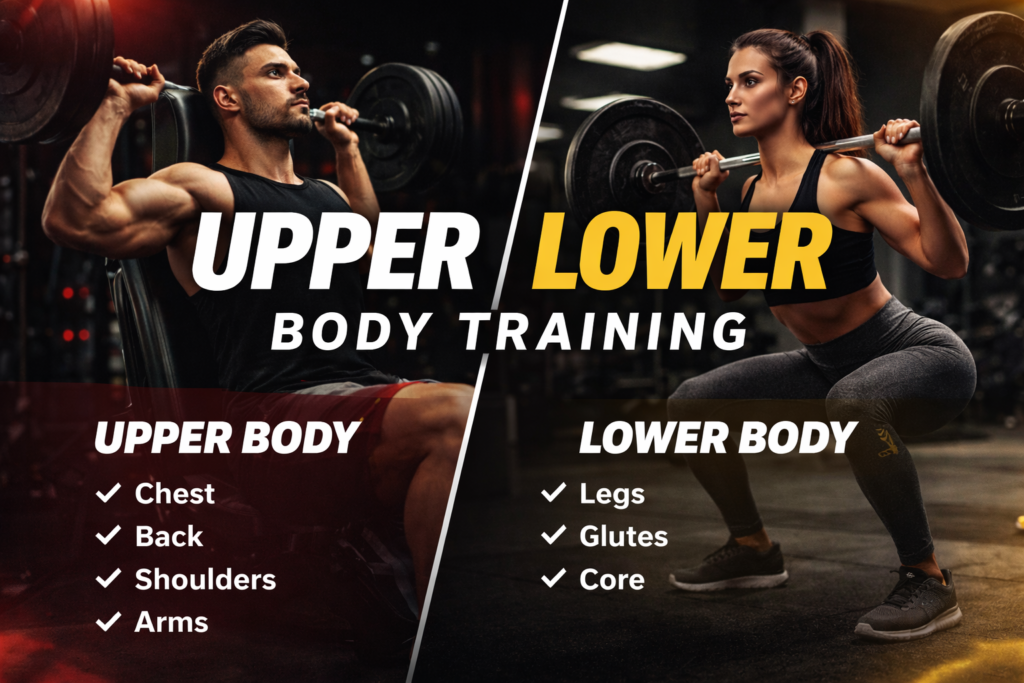
Most sessions should be structured to manage fatigue and prioritize major movements, you begin with working main muscle groups and proceed with smaller muscles loading them in the end of your session. In order to build more muscles quickly we’ll be aiming at 3 sets of 8-12 reps, as this would be optimal and joint-friendly for you as a beginner.
Typical weekly structure :
Day 1 – Upper
Day 2 – Lower
Day 3 – Rest
Day 4 – Upper
Day 5 – Lower
Day 6–7 – Rest or active recovery
How to structure Upper Body days?
Focus on movement patterns, not just muscles.
Include:
1–2 horizontal pushes (e.g. bench or dumbbell press)
1–2 horizontal pulls (e.g. rows)
1 vertical push (e.g. overhead press)
1 vertical pull (e.g. pull-ups or lat pulldown)
Arms & optional core
Reps & sets
Compounds: 3–4 sets of 5–10 reps
Accessories: 2–3 sets of 8–15 reps
How to structure Lower Body days?
Split your focus between knee-dominant and hip-dominant patterns.
Include:
Squat or leg press (quads)
Hinge movement (Romanian deadlift, deadlift, hip thrust)
Single-leg exercise (lunges, split squats)
Calves
Core (bird dog, kettlebell crunches, side planks)
Reps & sets
Main lifts: 2-3 sets of 5–8 reps
Accessories: 2–4 sets of 8–15 reps
Now I would want to come to something what would probably be the most important part for any of us, what actually delivers us gains, as no one would want to waste their time in the gym, and this crucial part is called ”progressive overload”.
Use progressive overload:
Add reps within a range
Increase weight slightly
Improve technique or control
Aim to train 1–3 reps shy of failure on most sets, saving true failure for accessories.
Conclusion
The upper/lower workout split is an effective training structure that targets each muscle group twice per week, blends compound lifts with accessory exercises, and focuses on progressive overload. By allowing adequate recovery between sessions, this split promotes consistent muscle growth, strength gains, and sustainable long-term results.