Full-body
Full body workouts are a simple and effective way to train the entire body in one session. They focus on major muscle groups using compound movements, making them ideal for beginners and anyone short on time. By training multiple muscles together, full body routines help build strength, improve coordination, and support consistent progress without overcomplicating your gym schedule.
From a physiological standpoint, full body training increases overall training frequency per muscle group while allowing sufficient recovery between sessions. Research suggests that stimulating muscles multiple times per week can support hypertrophy and strength gains when total volume is properly managed. Full body workouts also promote neuromuscular efficiency by reinforcing movement patterns and improving coordination across multiple joints.
Additionally, full body routines can be highly adaptable to different goals and fitness levels. Whether your aim is fat loss, muscle building, or general health, exercises can be modified in intensity, volume, and complexity to suit your needs. Incorporating variations such as free weights, resistance bands, or bodyweight exercises keeps workouts interesting while challenging your muscles in new ways. Over time, this adaptability helps prevent plateaus, maintain motivation, and encourage long-term consistency in your fitness journey.

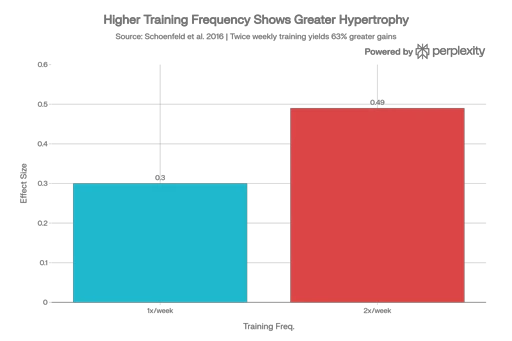
Meta-analytic data indicates training a muscle at least twice per week tends to produce more hypertrophy than once per week, with volume held equal.
- The bars show standardized hypertrophy effect sizes from a 2016 meta-analysis by Schoenfeld et al. comparing 1 vs 2 sessions per week per muscle group with weekly volume equated.
- Average effect size for once per week was about 0.30, while twice per week was about 0.49, indicating a moderate advantage for training each muscle at least two times weekly.
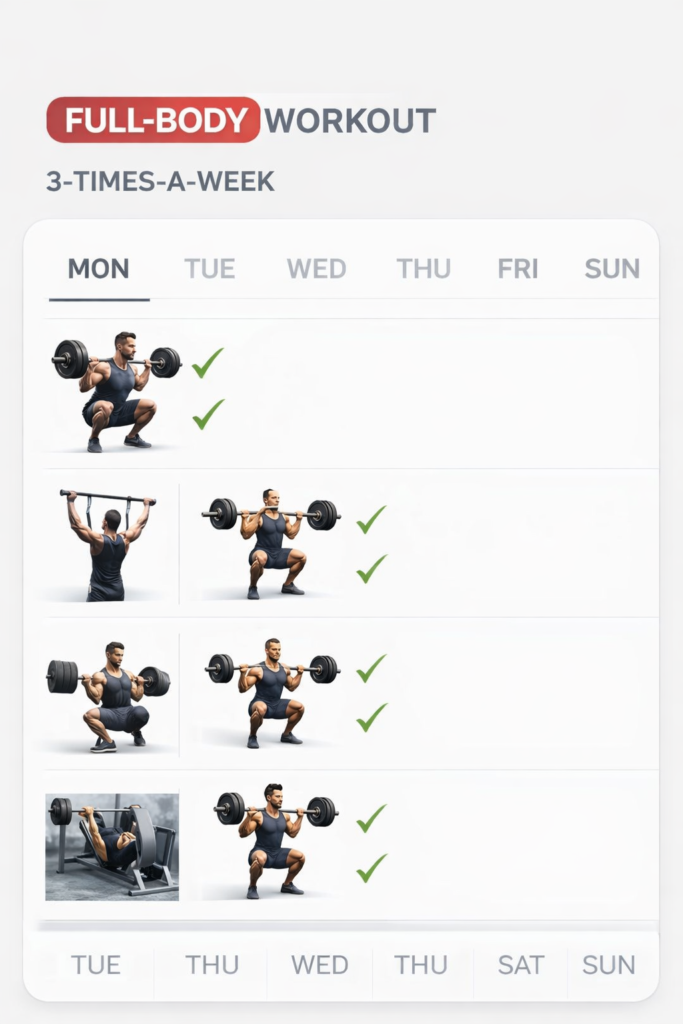
From my personal perspective, what makes full-body workouts especially appealing is how much more manageable leg training becomes. Instead of pushing legs to the extreme once every one or two weeks, full-body routines allow you to train them more frequently with lower fatigue per session, making progress feel more sustainable and less overwhelming.
Training muscles with lower reps more frequently (such as 6 reps, 2–3 times per week) is often more effective than high-rep workouts done once weekly. This approach stimulates muscle growth and strength more consistently, improves recovery, and allows heavier lifting with better technique. It also enhances neural adaptations, helping you get stronger over time while still supporting muscle development.
After a workout, muscle growth is driven by muscle protein synthesis, which typically remains elevated for 24–48 hours, and up to 72 hours in beginners. Training a muscle again within this window can help re-stimulate growth, which is why higher training frequency—paired with proper recovery—often produces better results than infrequent, high-fatigue sessions. Ultimately, total volume, recovery, and progression matter more than following a strict 72-hour rule.
A standard session for a full-body workout usually includes:
Lower-body compound (squat or leg press)
Hip hinge (deadlift or beginner friendly romanian deadlift)
Upper-body push (bench press, overhead press)
Upper-body pull (rows, pull-ups)
Accessory work (arms, shoulders, calves, or core)